Upgrading the Electrical System in a Thor Rize 18M (Without a Full Overhaul)
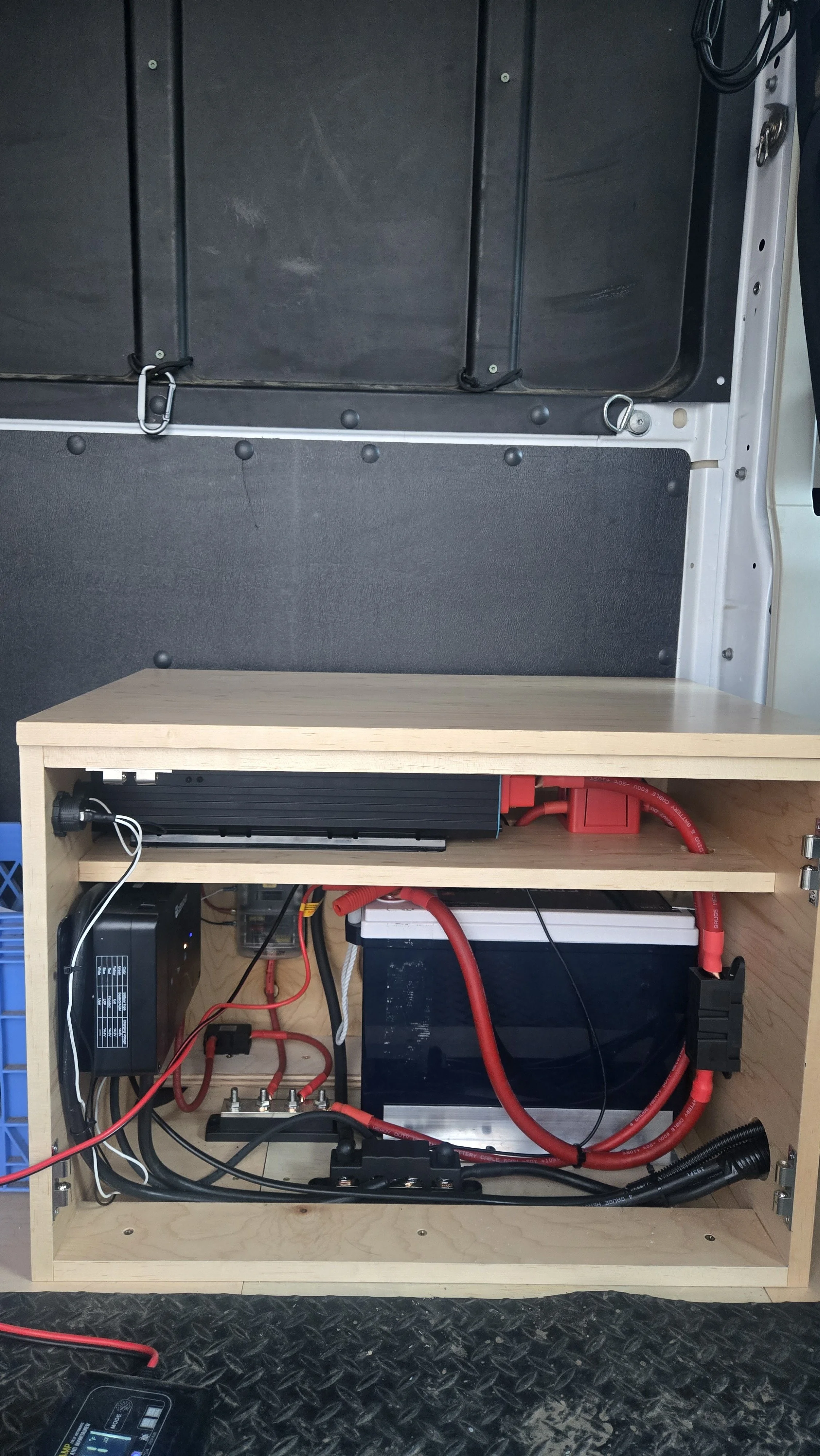
One of the most common issues we see with Class B motorhomes like the Thor Rize 18M is the electrical system.
Not because it’s completely broken, but because it’s often underbuilt for real-world use.
In this recent project, instead of doing a full system replacement, we focused on making targeted upgrades to improve performance and reliability.
The Starting Point: A Limited Factory System
Most Thor Rize vans come equipped with:
Around 200 amp hours of AGM batteries
A small solar setup (in this case, 150 watts)
A charging system based on a battery isolator (BIM 160)
For light use, this setup can work.
But for most van owners, especially those spending time off-grid, it quickly leads to a familiar problem:
Dead house batteries.
The Goal: Improve, Not Replace
Rather than completely stripping and rebuilding the system, we focused on supporting what was already there.
The goal was to:
Improve charging efficiency
Add supplemental power
Increase overall system reliability
Upgrade #1: Adding Solar Capacity
The van already had a 150W solar panel, but space limitations meant we could only add an additional 100W panel.
While that may not sound like a huge increase, every bit helps in a system like this.
We installed a 100W slim solar panel, giving the system a total of 250W.
It’s not a complete solution on its own, but it’s a meaningful improvement.
Upgrade #2: Switching to a DC-to-DC Charger
One of the biggest improvements we made was replacing the factory charging approach.
These vans typically use a BIM 160 battery combiner, which we’re not fans of.
Why?
It doesn’t provide clean or consistent charging
It can be hard on batteries and components
It’s generally an outdated approach compared to newer technology
Instead, we installed a Victron Orion XS50 DC-to-DC charger.
This provides:
More controlled, efficient charging
Better battery health over time
A more reliable system overall
What We Did With the BIM 160
We didn’t remove the BIM entirely.
Instead, we:
Disabled its charging function by disconnecting the ignition wire
Left the emergency start feature intact
This means:
If the house batteries are drained, the client can still use the emergency start function to pull power and start the vehicle.
So the system still serves a purpose, just not as the primary charging method.
The Result: A Better-Performing System
This wasn’t a full lithium conversion or a complete electrical rebuild.
But the upgrades made a noticeable difference:
Better charging while driving
Increased solar input
Improved overall system reliability
Less strain on the batteries
When Upgrades Make More Sense Than a Full Rebuild
Not every van needs a full electrical overhaul.
In many cases, especially with newer Class B vans, targeted upgrades can go a long way.
The key is understanding:
Where the system is falling short
What improvements will actually make a difference
How to implement those upgrades correctly
Final Thoughts
If you own a Thor Rize (or a similar Class B) and find yourself constantly running out of power, you’re not alone.
The good news is that you don’t always need to start from scratch.
Sometimes, a few well-planned upgrades can turn an underperforming system into something far more usable.
And that’s exactly what we aim to do.
Need some help? Contact us!