Saving Weight in Your camper Van Build: When Lightweight Goes Too Far
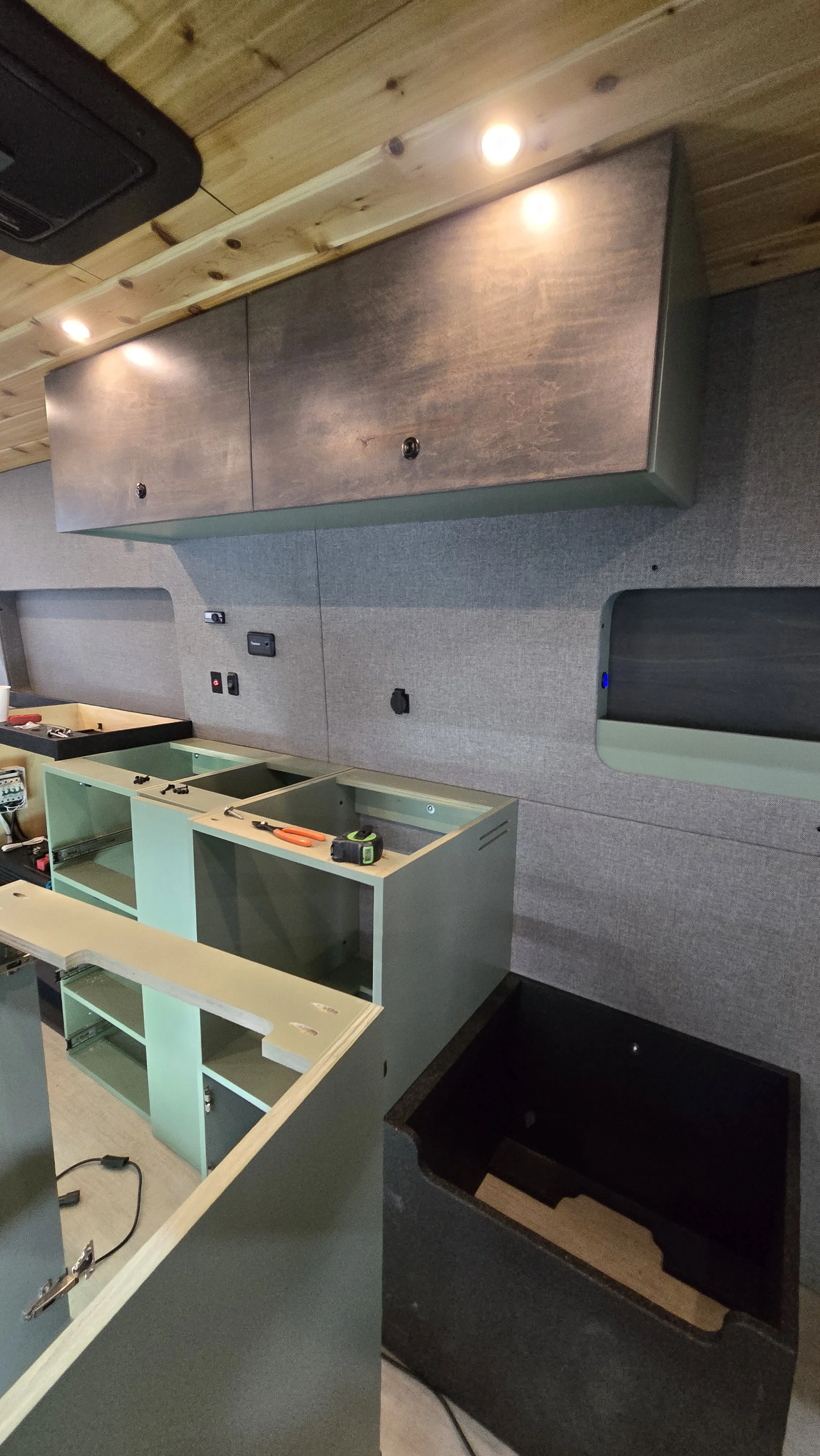
Weight is one of those topics that comes up constantly when you're building a camper van.
And for good reason. A van has a finite payload capacity, and everything you add—from cabinetry and appliances to batteries, water, gear, and passengers—adds weight.
So naturally, DIY builders and van owners start looking for ways to save a few pounds wherever they can.
But there's an important distinction between building efficiently and building too lightly.
We've recently been working on a van where the owner was having problems with the drawers. When we took a closer look, the reason was pretty clear: the drawer boxes and faces had been built from ¼-inch plywood.
It was lightweight.
But it wasn't durable enough for what the drawers were being asked to do.
Lightweight Doesn't Always Mean Better
We completely understand the desire to save weight.
If you can remove unnecessary weight from a van, that's generally a good thing. Less weight can mean less strain on the vehicle and potentially better fuel economy.
But there are certain parts of a van build where durability matters more than saving a few pounds.
Cabinetry and drawers are good examples.
These aren't decorative pieces. They're going to be opened, closed, loaded with gear, and subjected to the constant movement and vibration of a vehicle traveling down the road.
A material that might work perfectly well in a stationary application may not hold up as well in a van.
That's why we always encourage DIY builders to think about where they're saving weight.
The Math Matters but So Does the Application
For some perspective, a sheet of ¾-inch plywood weighs roughly 65 pounds, while a sheet of ½-inch plywood is around 40 pounds.
That's a meaningful difference.
But think about how much plywood actually goes into a full van build.
A build might use around eight sheets of plywood, depending on the design and materials.
At that point, you have to ask yourself: Is saving that weight in every single component worth sacrificing durability?
Sometimes the answer is yes.
Often, it isn't.
If you're trying to shave 20 or 30 pounds from your overall build, there may be better places to find those pounds than making your drawers, cabinetry, or other heavily used components unnecessarily thin.
Your Van Is a Moving Vehicle
This is the part that can be easy to overlook when you're designing a build.
A van isn't a house.
Everything inside it is being subjected to movement, vibration, bumps, temperature changes, and repeated use.
Your cabinets aren't sitting on a stationary floor.
Your drawers aren't being opened and closed in a kitchen that never moves.
Your bed, seating, storage, and other components are all experiencing forces that simply don't exist in the same way in a traditional home.
That's why how something is built matters just as much as what it looks like.
Where Should You Save Weight?
If you're trying to keep your build within your vehicle's payload limits, start by looking at the entire system rather than making every individual component as lightweight as possible.
Depending on your build, that could mean evaluating:
Cabinet and storage layouts
Appliances
Water capacity
Battery capacity
Flooring materials
Exterior accessories
Unnecessary features or duplicated systems
The amount of gear you actually plan to carry
You can also look at construction techniques and materials that provide the strength you need without adding unnecessary bulk.
The goal isn't to build the heaviest van possible.
It's also not to build the lightest van possible.
The goal is to build a van that is appropriately engineered for how you'll use it.
Build for Real Life
This is something we think about with every build we work on.
We want the van to be functional, durable, and comfortable, not simply impressive on paper.
Saving weight is absolutely worth considering.
But if saving 10 pounds means you're going to have to rebuild a drawer, replace cabinetry, or repair something repeatedly, you've probably saved weight in the wrong place.
And that's especially important for DIY builders because mistakes like this can become expensive once you've already built around them.
Build it once. Build it for the way you're actually going to use it.
If you're planning a DIY van build and want help thinking through materials, systems, layout, or construction before you start buying products, a diagnostic session can help you create a solid plan before you commit.
Need help with your cabinets? Book your diagnostic appointment below and we’ll help you get it done!